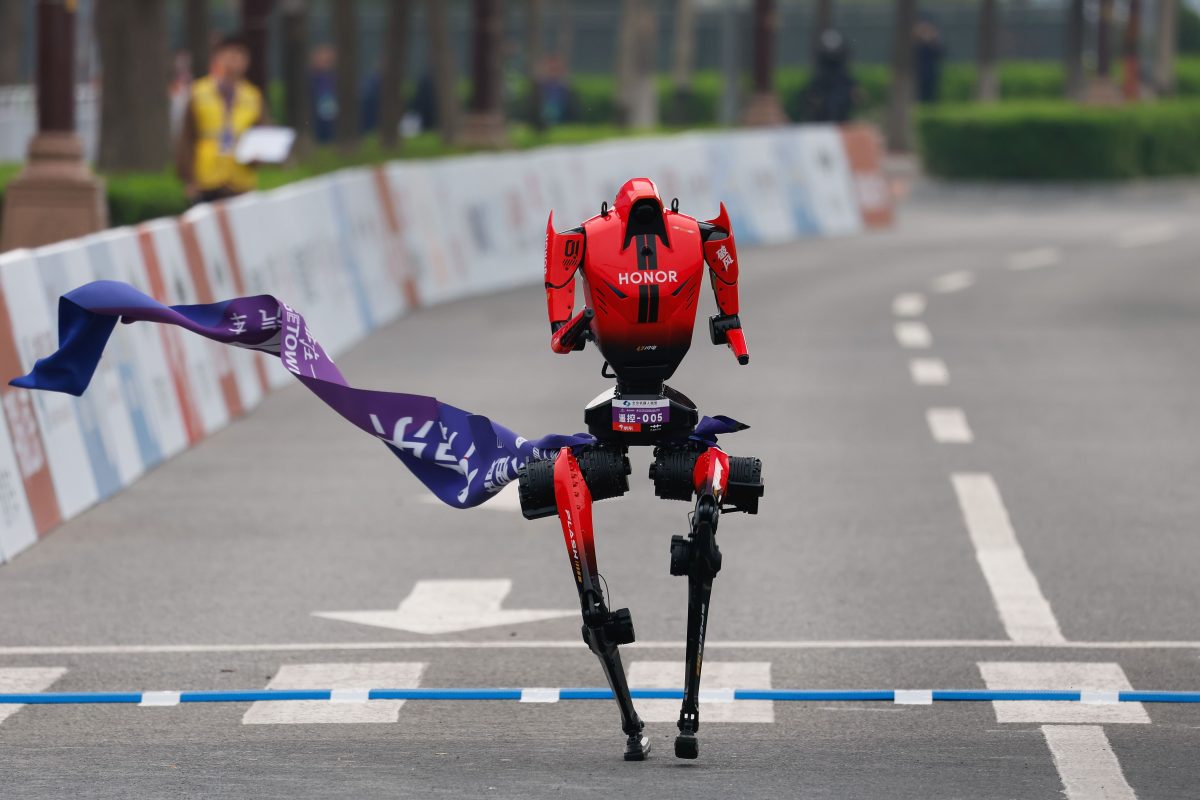

A significant milestone in robotics and endurance performance was recorded in China recently. An autonomous humanoid robot developed by the technology company Honor completed a half-marathon distance, a challenging 13.1-mile course, in a time of 50 minutes and 26 seconds.
This performance notably surpasses the current human world record for the half-marathon by approximately seven minutes. The achievement highlights rapid advancements in bipedal locomotion, power efficiency, and real-time environmental navigation for autonomous machines.
Context and Technological Significance
The event underscores a focused effort within the robotics industry to develop machines capable of operating in human-centric environments. Successfully navigating a long-distance, variable-terrain course requires a sophisticated integration of hardware and software systems.
Key challenges for such a robot include maintaining dynamic balance over extended periods, managing battery power efficiently, and processing sensor data to avoid obstacles in real time. Completing a half-marathon demonstrates progress in solving these complex engineering problems.
While specific technical specifications of the robot were not detailed in the initial report, performances of this nature typically rely on advanced actuators, lightweight composite materials, and machine learning algorithms for gait optimization and energy management.
Industry Reactions and Benchmarking
The robotics community often uses specific physical benchmarks to measure progress. Endurance running presents a unique and demanding test case, combining stamina, mechanical resilience, and computational decision-making.
Analysts note that achievements like this one move beyond controlled laboratory demonstrations. They show a capability for sustained operation in less predictable, real-world settings, which is a critical step for practical applications.
Potential future applications for such robust humanoid robots are frequently discussed in fields like logistics, emergency response, and advanced manufacturing. Demonstrating endurance and reliability is a prerequisite for these roles.
It is important to contextualize this record within the specific domain of machine performance. Direct comparisons to human athletic records are illustrative of progress but represent different physiological and mechanical paradigms.
Future Trajectory and Next Steps
The successful half-marathon run is expected to be followed by further public demonstrations and more detailed technical disclosures from the development team. The industry will be watching for published papers or presentations that break down the robot’s power systems, control software, and mechanical design.
Logical next steps include attempts at longer distances, more varied and difficult terrain, or integrating additional tasks during locomotion. The broader goal remains creating versatile robots that can assist in diverse scenarios.
Official timelines for commercial or industrial deployment of such platforms are rarely announced immediately following a technical demonstration. However, milestones of this magnitude typically accelerate research funding and spur competitive developments from other organizations globally.
Future developments will likely focus on improving efficiency to extend operational range, enhancing AI for more complex navigation, and refining designs for cost reduction and durability. The next major public benchmark may involve a full marathon distance or operation in a fully unstructured outdoor environment.