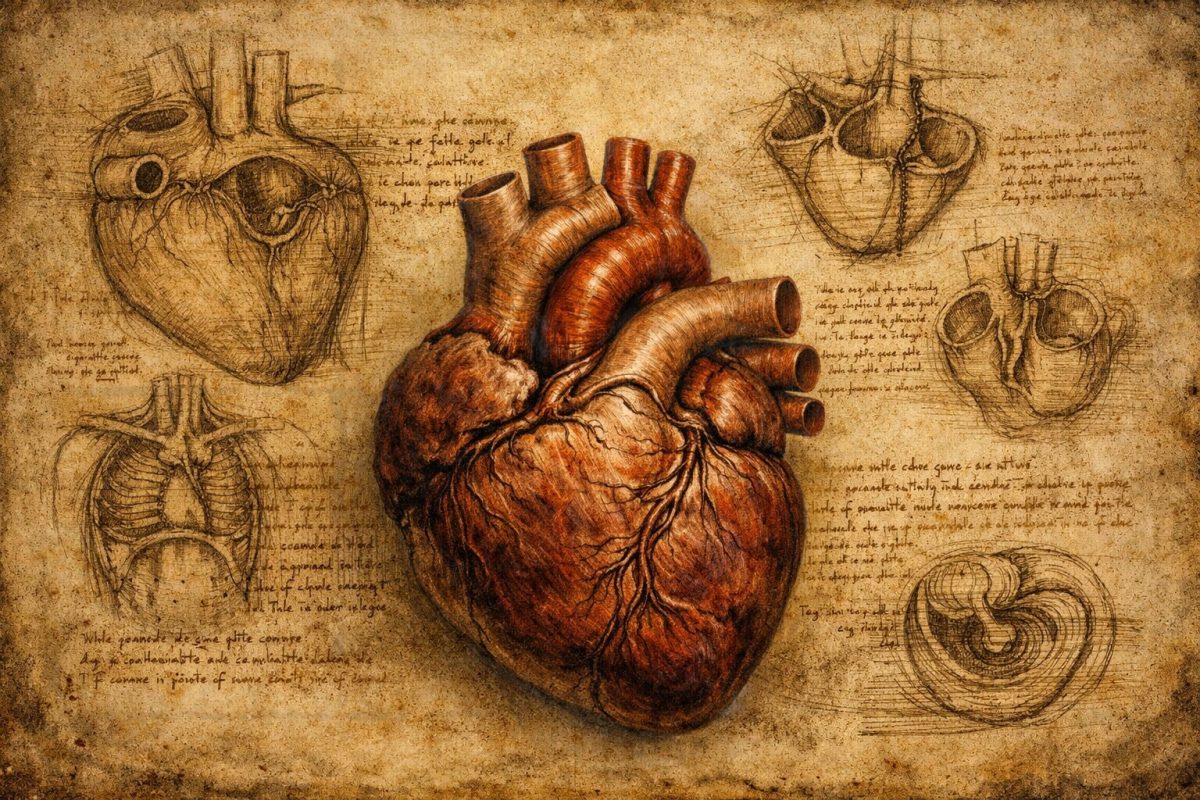

More than five centuries after Leonardo Da Vinci meticulously drew the human heart, his anatomical studies are yielding new insights into cardiovascular health. Researchers have analyzed Da Vinci’s detailed sketches of the heart’s trabeculae, the irregular muscular columns inside the heart chambers, and linked their structure to the risk of heart disease.
Da Vinci’s drawings, created in the early 16th century, were remarkably accurate given the limited tools available at the time. He observed that the trabeculae, which appear as a network of fleshy strands, varied widely among individuals. Modern scientists, using advanced imaging techniques, have now confirmed that these variations are not random, they correlate with inherited genetic factors and may predict susceptibility to conditions such as heart failure and arrhythmias.
A Renaissance Blueprint for Modern Medicine
The study, published in a leading medical journal, reexamined Da Vinci’s original sketches alongside contemporary MRI scans of living hearts. By mapping the density and pattern of trabeculae, researchers found that individuals with more complex trabecular networks had a higher likelihood of developing cardiac complications later in life. Da Vinci had already suggested that the heart’s internal structure could influence function, a hypothesis that took centuries to verify.
Leonardo’s anatomical work was not widely known during his lifetime. Much of it remained in private notebooks until the 19th and 20th centuries. Today, these notebooks are considered invaluable scientific artifacts. The current findings underscore the relevance of Renaissance observational science to genomic and clinical research.
Decoding the Trabeculae
Cardiac trabeculae are not merely structural fillers. They allow blood to flow efficiently through the heart during development and help coordinate contraction. The new research demonstrates that genetic variants that influence trabecular formation also affect the risk of dilated cardiomyopathy, a condition where the heart becomes enlarged and weakened. Da Vinci’s detailed illustrations captured these subtle differences in shape and density, differences that are now measurable with algorithms trained on thousands of patient scans.
Scientists involved in the study emphasized that Da Vinci’s observations align with data from the UK Biobank, a large-scale biomedical database. By linking his anatomical sketches to modern population-level genetics, the team created a more complete picture of how heart structure develops and how it can go wrong.
Implications for Preventive Cardiology
The practical application of this research lies in early risk stratification. If a simple scan can identify trabecular patterns associated with higher disease risk, doctors may be able to recommend lifestyle changes or monitoring before symptoms appear. This shift toward prevention rather than treatment echoes Da Vinci’s own pursuit of understanding the body as an integrated system.
Dr. Sarah Mitchell, a cardiologist not affiliated with the study, noted that while trabecular analysis is not yet standard in clinical practice, the findings provide a strong rationale for incorporating such imaging into routine health screenings, especially for patients with a family history of heart disease.
The research also raises questions about how many more medical insights lie hidden in historical manuscripts. Da Vinci’s work is just one example of premodern science anticipating modern discoveries. His precise measurements and curiosity about the mechanics of life continue to inform disciplines he could not have imagined, from genetics to computational anatomy.
Looking ahead, researchers plan to extend the analysis to other populations and investigate whether trabecular patterns change with age or in response to treatment. Clinical trials may follow to test whether early intervention based on trabecular profiling can reduce heart failure rates. The timeline for any new screening protocol is likely several years away, but the foundational work, guided by a Renaissance polymath, is already in place.