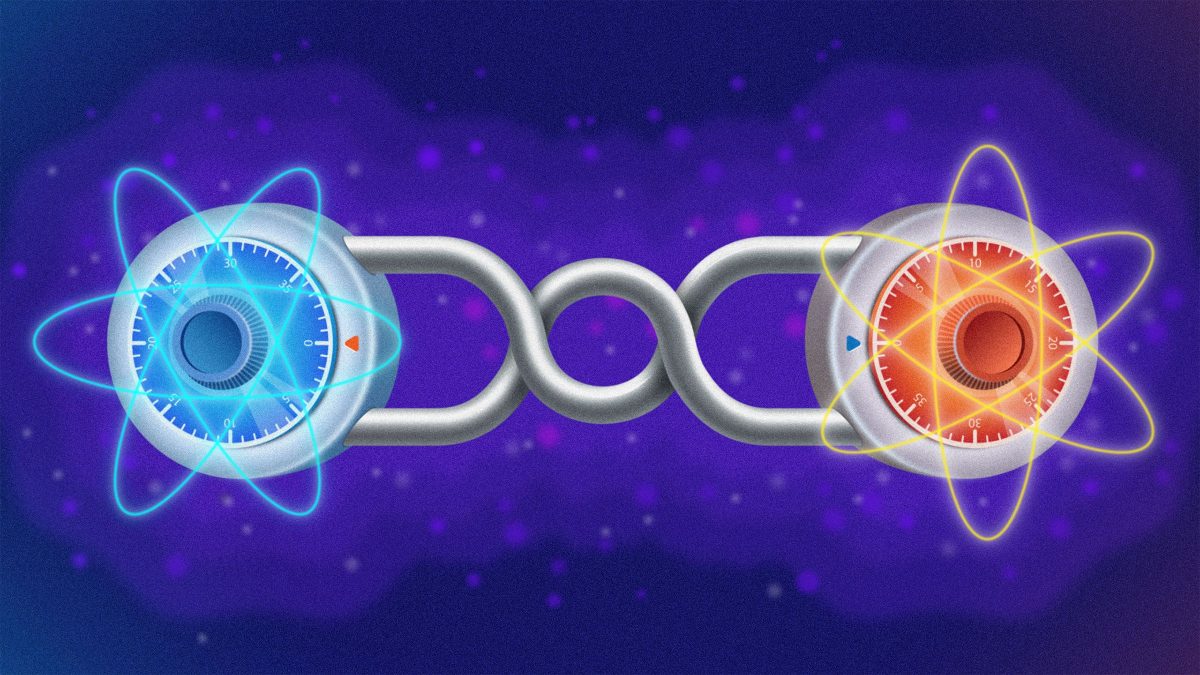

Cryptographers working to protect communications in a post-quantum era are turning to a novel concept known as quantum jamming, a phenomenon that may help clarify how cause and effect operate at the most fundamental levels of physics.
This emerging field of study examines how quantum systems can interfere with each other in ways that resemble a kind of signal blockage or coherence loss, similar to radio jamming but governed by quantum mechanical principles. Researchers believe that understanding quantum jamming could lead to new methods for securing data against future attacks from quantum computers.
Background on Quantum Jamming
Quantum jamming occurs when entanglement between particles is disrupted by external interactions, preventing the intended flow of quantum information. Unlike classical jamming, which simply blocks or overpowers a signal, quantum jamming can alter the very correlations that underpin quantum cryptography protocols.
Scientists at several institutions, including the University of Cambridge and the Institute for Quantum Optics and Quantum Information in Vienna, have published studies detailing how jamming effects can be modeled and potentially controlled. Their work suggests that by deliberately introducing controlled jamming, it may be possible to create communication channels that are inherently resistant to eavesdropping, even by quantum computers.
Implications for Digital Security
Current encryption methods, such as RSA and elliptic curve cryptography, rely on mathematical problems that classical computers find difficult. Quantum computers, however, could solve these problems rapidly, threatening the security of online transactions, private messages, and domain name system infrastructure.
Quantum key distribution, a technology already in limited use, offers a potential solution by using entangled particles to share encryption keys. Any attempt to intercept the key would disturb the quantum state, alerting both parties. Quantum jamming research could strengthen this approach by providing a framework to understand and mitigate unintended disruptions, as well as to design protocols that exploit jamming for security.
Domain registrars and hosting companies that manage critical internet infrastructure are beginning to monitor these developments. While quantum jamming is not yet a commercial technology, its theoretical progress could influence how domain name system security standards evolve over the next decade.
Reactions from the Cryptographic Community
NIST, the U.S. National Institute of Standards and Technology, is already in the process of standardizing post-quantum cryptographic algorithms. Experts in quantum information science note that jamming studies complement these standardization efforts by addressing physical layer security, not just mathematical algorithms.
Dr. Elena Gerrits, a quantum physicist at the University of Oxford, commented that understanding quantum jamming is essential for building robust quantum networks. Without such knowledge, she noted, future quantum internet infrastructure could be vulnerable to accidental or malicious jamming that degrades performance or creates security loopholes.
Other researchers caution that quantum jamming is still largely theoretical and that practical applications remain years away. However, the concept has already inspired new lines of inquiry into causality itself, as jamming effects can mimic or disrupt the expected flow of cause and effect in quantum systems.
For domain name registrars like 4T Registrar, which provide domain registration and hosting services, the long term outlook includes preparing for a transition to quantum resistant protocols. Though no immediate changes to domain registration processes are required, the industry is closely following cryptographic advances to ensure that customer data and domain ownership records remain secure in a quantum computing future.
Expected Developments and Timelines
NIST expects to finalize its first set of post-quantum cryptographic standards by 2024, with adoption by major technology companies and internet service providers anticipated in the following years. Quantum jamming research is expected to feed into these standards indirectly, influencing best practices for quantum key distribution networks.
Several university labs are planning experimental demonstrations of controlled quantum jamming within the next two to three years. If successful, these experiments could pave the way for prototype communication systems that use jamming as a security feature rather than treating it as a problem.
The broader implication for causality research remains an open question. Some physicists argue that quantum jamming may reveal new aspects of how events relate to one another at microscopic scales, potentially challenging classical notions of cause and effect. For now, the primary focus remains on practical security as the quantum era approaches.